
The Blind Spot Problem: What Your Team Cannot See Because Everyone Sees the Same Way

There is a particular organizational failure mode that is almost impossible to see from the inside. It does not show up in performance metrics, at least not immediately. It does not produce obvious warning signals. It lives in the absence of things: the concern that was not raised, the risk that was not seen, the solution that was never considered because it came from a frame of reference no one in the room had.
It is the blind spot failure mode. And it is produced by sameness.
Every perspective carries its own blind spots. The experiences you have had shape what you see. They also shape what you do not see, what does not register as noteworthy, what does not fit the pattern of how risk or opportunity tends to present itself in your worldview. You cannot see what your own perspective has no category for. And the most sophisticated, experienced, credentialed individual in the world has perspectives they cannot see past.
This is why diversity of perspective is not primarily a social value in organizational contexts, though it is that too. It is an information quality mechanism. A team that sees the same problem from genuinely different angles is working with a richer and more complete information set than a team that sees it from one. The decision that emerges from that richer information set is more likely to be well-calibrated and more likely to survive contact with reality.
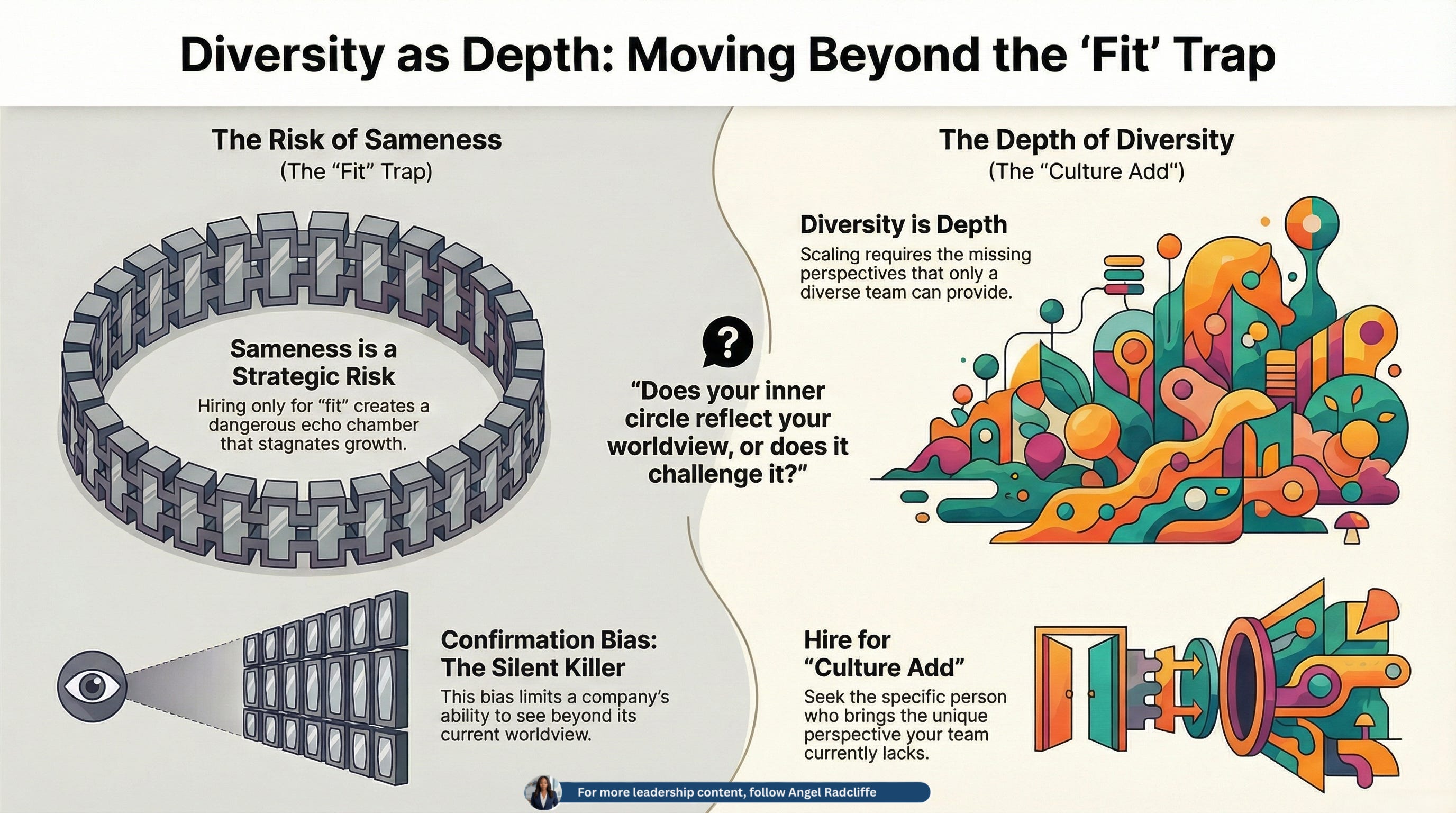
The challenge is not assembling a diverse team. The challenge is creating the conditions in which diverse perspectives actually reach and influence decisions. A meeting room where one perspective consistently dominates, regardless of the diversity of backgrounds present, is not producing the benefit that diversity makes possible. The integration of diverse perspectives requires deliberate investment: inclusive facilitation, active invitation of dissenting views, and a leader who genuinely values being surprised by a perspective they had not considered.
What is your team collectively unable to see? And what would you need to change about your team's composition or culture to start seeing it?
This scenario is also shared on LinkedIn, with a companion podcast deep dive exploring the leadership dynamics behind the decision.
If this scenario resonates, share how you’d approach it or pass it to a leader who’s navigating something similar.
If you’re second-guessing how you’d handle this, you should be.
I break down what’s actually happening—and what to say instead—inside Leadership Uncensored.
👉 Upgrade to read the full breakdown